Unlocking Enterprise-Grade AI: A Deep Dive into NVIDIA's Free API Catalog
For developers and creators building next-generation applications, accessing state-of-the-art AI models usually comes with a catch: expensive API usage fees or the need for massive local GPU infrastructure.
However, NVIDIA has disrupted this barrier to entry with the NVIDIA API Catalog and NIM (NVIDIA Inference Microservices). This platform allows developers to access, test, and deploy highly optimized open-weight models—completely free during the evaluation phase—using an infrastructure designed for maximum inference speed.
Here is a complete guide to understanding, accessing, and integrating NVIDIA's free API endpoints into your own software projects.
What is NVIDIA NIM?
NVIDIA NIM is a set of optimized cloud-native microservices designed to simplify and accelerate the deployment of generative AI models. Instead of manually configuring environments, installing drivers, and optimizing weights for specific GPUs, NIM packages everything into a standardized, ready-to-deploy container.
For developers testing the waters, the NVIDIA API Catalog hosts these NIM endpoints in a serverless environment. This means you can ping the models via API directly from your browser or codebase without managing any hardware. The underlying runtime uses TensorRT-LLM, ensuring ultra-low latency and high throughput.
The Credit System and Free Endpoints
NVIDIA offers a generous trial experience so developers can prototype applications risk-free:
- Initial Sign-Up: Creating a free account immediately grants you 1,000 API credits.
- Enterprise Extension: By registering with a corporate or institutional email address, you can unlock an additional 4,000 credits (totaling 5,000) and a 90-day NVIDIA AI Enterprise evaluation license.
- Completely Free Endpoints: NVIDIA frequently designates certain models as "Free Endpoints." These specific endpoints do not consume your API credits, allowing for virtually unlimited prototyping and testing.
A Massive Library of Open-Weight Models
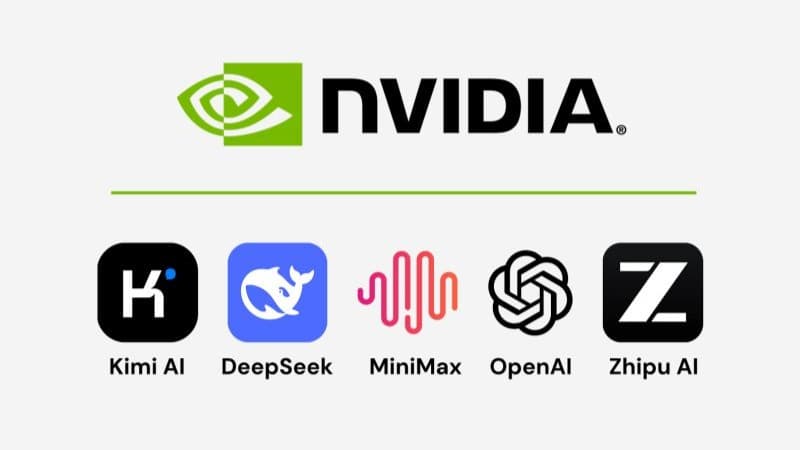
The API Catalog does not limit you to a single ecosystem. It aggregates the most powerful open-weight models across the industry, optimized to run on NVIDIA hardware.
| Model Family | Key Strengths | Popular Use Cases |
|---|---|---|
| DeepSeek | Powerful Mixture-of-Experts (MoE) architecture, advanced reasoning | Complex coding, long-horizon logic |
| Meta Llama 3.1 & 3.3 | High efficiency, strong instruction following | Chatbots, general text generation |
| NVIDIA Nemotron | Native NVIDIA models, robust visual-language capabilities | OCR, agentic reasoning, multimodal tasks |
| Alibaba Qwen | Strong multilingual support, high performance | Global applications, versatile text processing |
| Moonshot Kimi | Extended context windows, specialized thinking models | Document analysis, AI agents |
How to Integrate the API (In 4 Steps)
The biggest advantage of the NVIDIA API Catalog is its OpenAI compatibility. If your existing codebase, agent framework, or IDE extension supports OpenAI, you can point it to NVIDIA NIM by changing just two lines of code.
Step 1: Create an Account Navigate to
build.nvidia.comand sign up. Verify your email to access the catalog.
Step 2: Generate Your API Key Go to your profile settings and generate an API key. It will begin with
nvapi-. Keep this secure, as it will only be shown once.
Step 3: Update Your Base URL Instead of routing your requests to standard OpenAI servers, redirect them to NVIDIA's serverless endpoint:
https://integrate.api.nvidia.com/v1
Step 4: Execute Your Code Whether you are using direct HTTP calls, Python scripts, or frameworks like AutoGen and CrewAI, simply pass your new base URL, your
nvapi-key, and the specific model identifier (e.g., meta/llama-3.1-8b-instruct).
Accelerating High-Velocity Development
For developers participating in hackathons or building rapid prototypes, the NVIDIA API Catalog removes the friction of hosting hardware. You can seamlessly route high-stakes reasoning tasks to heavy models like DeepSeek, while offloading simple summarization tasks to lightning-fast, free-tier models—all through a single, unified API gateway.
By leveraging NIM, you ensure that when your prototype is ready to scale into production, the models are already packaged in enterprise-ready containers, ready to be deployed on your own cloud or on-premise infrastructure.